
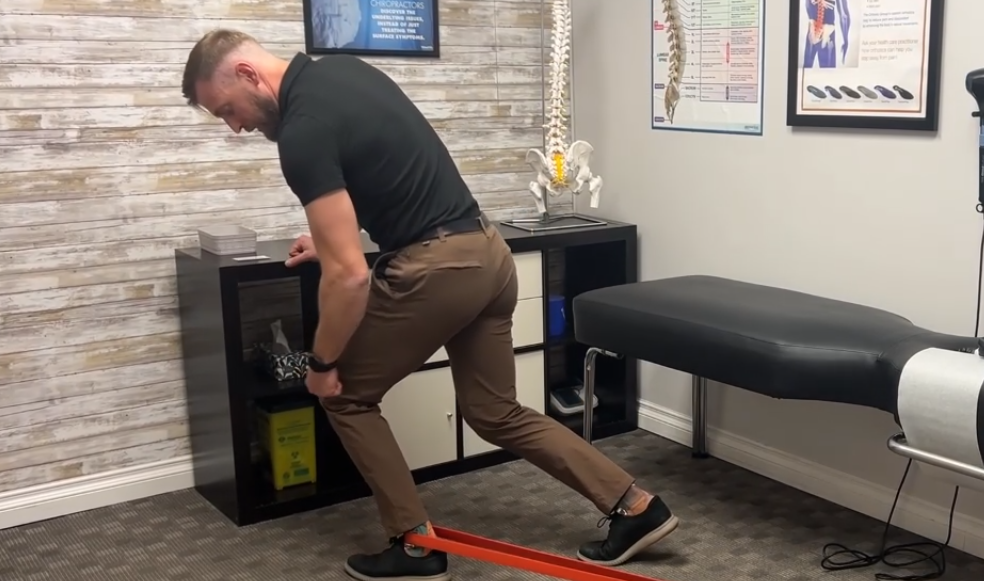
Banded Ankle Mobility Stretch:
A Simple Exercise to Improve Dorsiflexion
What You’ll Need
To perform this stretch, you’ll need:
- A resistance band approximately 1 inch wide
- A sturdy anchor point such as:
- A couch leg
- Bed frame
- Heavy piece of furniture
- Exercise rack
The anchor point should be secure and unable to move while you perform the exercise.
How to Perform the Banded Ankle Mobility Stretch
Step 1: Anchor the Band
Secure the resistance band around a stable object near floor level.
Step 2: Position the Band
Place the band around the front of your ankle, just above the foot and near the bottom of the ankle joint.
Step 3: Create Tension
Step forward until there is moderate tension in the band.
The band should gently pull your ankle backward toward the anchor point.
Step 4: Bend the Ankle
Keeping your heel flat on the floor, slowly drive your knee forward over your big toe.
Your goal is to bring your shin forward while allowing the ankle to move into dorsiflexion.
Think about bringing your toes toward your shin.
Step 5: Move Through the Range
Rather than holding a static position, slowly move in and out of the stretch.
Work through your comfortable range of motion while maintaining band tension.
How Long Should You Do It?
Perform the exercise for:
30 seconds per ankle
Then switch sides and repeat.
If both ankles are restricted, perform:
- 30 seconds on the first side
- 30 seconds on the second side
- Repeat the sequence once more
Total time:
1–2 minutes
How Often Should You Do It?
For General Mobility
- 3–4 times per week
For Significant Stiffness
- Daily
Before Exercise or Sports
- As part of a warm-up routine
Many athletes find this exercise particularly useful before squatting, running, jumping, or field sports.
Easier Version
If this exercise feels uncomfortable:
Reduce Band Tension
Move closer to the anchor point.
Limit the Range
Only move the knee forward as far as comfortable.
Hold Onto Support
Use a wall or chair for balance if needed.
Harder Version
Once mobility improves:
Increase Band Tension
Step farther away from the anchor point.
Add More Repetitions
Perform multiple 30-second sets.
Use During Warm-Ups
Incorporate the movement before squats, lunges, and athletic activities.
Perform a Knee-to-Wall Test
Challenge yourself by measuring how far your foot can be from a wall while still allowing your knee to touch the wall without lifting the heel.
Common Mistakes to Avoid
Letting the Heel Lift
Keep your heel firmly planted throughout the movement.
Moving Too Quickly
Slow, controlled movements help the joint adapt more effectively.
Using Excessive Band Tension
More tension is not always better. Moderate tension is usually sufficient.
Forcing Painful Motion
You should feel stretching and joint movement—not sharp pain.
What Should You Feel?
You may notice:
✅ A stretch in the ankle joint
✅ Increased movement in the front of the ankle
✅ Improved ability to move the knee over the toes
✅ Less stiffness after completing the exercise
You should not feel:
❌ Sharp pain
❌ Pinching that worsens with movement
❌ Significant swelling
❌ Numbness or tingling
If these symptoms occur, discontinue the exercise and seek professional guidance.
Limited ankle mobility is one of the most common movement restrictions we see in both athletes and non-athletes alike. Whether you’re squatting, running, climbing stairs, or simply walking, healthy ankle motion is essential for efficient movement.
The Banded Ankle Mobility Stretch is a simple exercise that can help improve ankle flexibility, increase dorsiflexion, and restore normal movement mechanics.
Why Ankle Mobility Matters
Your ankle needs to move freely in multiple directions, but one of the most important movements is dorsiflexion—the ability to bring your toes toward your shin.
When ankle dorsiflexion is limited, it can contribute to:
- Difficulty squatting deeply
- Heel lifting during squats
- Reduced running efficiency
- Increased stress on the knees
- Increased stress on the Achilles tendon
- Balance and stability problems
- Compensatory movement patterns throughout the body
Improving ankle mobility can often lead to better movement quality and reduced strain on surrounding joints.