
If you’ve been dealing with heel pain that shoots through the bottom of your foot the moment you take your first steps in the morning, you already know how disruptive plantar fasciitis can be. It’s one of those conditions that sounds manageable until you’re actually living with it. The morning stiffness, the way it eases up after a few minutes only to come roaring back after you’ve been sitting for a while, the way it limits what you can do and how long you can stay on your feet.
Most people with plantar fasciitis try the standard approach first. Rest, stretching, ice, better footwear, maybe a cortisone injection. And for some people, that’s enough. But for a significant number of patients, the pain keeps coming back, or never fully goes away, no matter how diligently they follow the usual advice. If that sounds like your situation, shockwave therapy may be worth understanding.
What Is Plantar Fasciitis?
The plantar fascia is a thick band of connective tissue that runs along the bottom of your foot, connecting your heel bone to the base of your toes. Its job is to absorb load and support the arch with every step you take. When that tissue is repeatedly stressed beyond its capacity, small tears develop at the attachment point near the heel, triggering pain and inflammation.
The term fasciitis implies active inflammation, but research has shown that chronic plantar fasciitis is often less about ongoing inflammation and more about a degenerative process in the tissue itself. The fascia fails to complete its healing cycle, the collagen structure becomes disorganized, and the area becomes stuck in a chronic, painful state without ever fully resolving.
This distinction matters because it explains why anti-inflammatory approaches like ice, NSAIDs, and cortisone injections often provide only temporary relief for chronic cases. If the tissue isn’t actually inflamed but rather degenerated and stuck, reducing inflammation doesn’t fix the underlying problem.
Why Plantar Fasciitis Can Be So Stubborn
Tendons and fascial tissue have a notoriously poor blood supply compared to muscle. Blood flow is how the body delivers the nutrients, growth factors, and cellular signals needed to repair damaged tissue. Limited blood supply means limited healing capacity, which is why plantar fasciitis that has been present for months or years often doesn’t respond to rest and conservative care the way an acute muscle strain would.
The body isn’t ignoring the injury. It’s trying to heal it. But without sufficient blood flow to the area, the repair process stalls. The tissue remains in a chronic, partially healed state that’s painful, vulnerable to re-injury, and resistant to the things that usually help.
This is the biological basis for why shockwave therapy works as well as it does for plantar fasciitis specifically, and why it’s become one of the most researched non-surgical interventions for the condition.
How Shockwave Therapy Addresses Plantar Fasciitis
Shockwave therapy delivers controlled mechanical pressure waves into the affected tissue. These waves create a brief, controlled microtrauma in the treatment area that triggers a cascade of biological responses including increased blood flow, the release of growth factors, stimulation of collagen production, and the breakdown of calcifications or scar tissue that may have accumulated at the fascial attachment.
In simpler terms, shockwave gives the tissue the mechanical stimulus it needs to restart a healing process that has stalled. It doesn’t mask the pain or reduce inflammation temporarily. It works at the tissue level to promote actual structural repair.
For plantar fasciitis specifically, the treatment is typically applied at the heel where the plantar fascia attaches to the calcaneus, the area where most patients experience their worst pain. The waves penetrate into the tissue and stimulate the repair response in exactly the area that needs it most.
What Does the Research Say?
Shockwave therapy for plantar fasciitis is one of the more well-researched applications of the technology. Multiple randomized controlled trials and systematic reviews have examined its effectiveness, and the evidence is consistently positive, particularly for chronic cases that haven’t responded to other conservative treatments.
A systematic review published in the Journal of Orthopaedic Surgery and Research found that shockwave therapy produced significant reductions in pain and improvements in function for patients with chronic plantar fasciitis. Studies comparing shockwave to cortisone injections have generally found that while cortisone may provide faster initial relief, shockwave produces more durable long-term outcomes with lower rates of recurrence.
The research also supports shockwave as a safe intervention with a low risk of serious adverse effects, making it an appropriate option for patients who want to avoid injections or surgery.
What to Expect From Shockwave Treatment for Plantar Fasciitis at Riverside Chiropractic
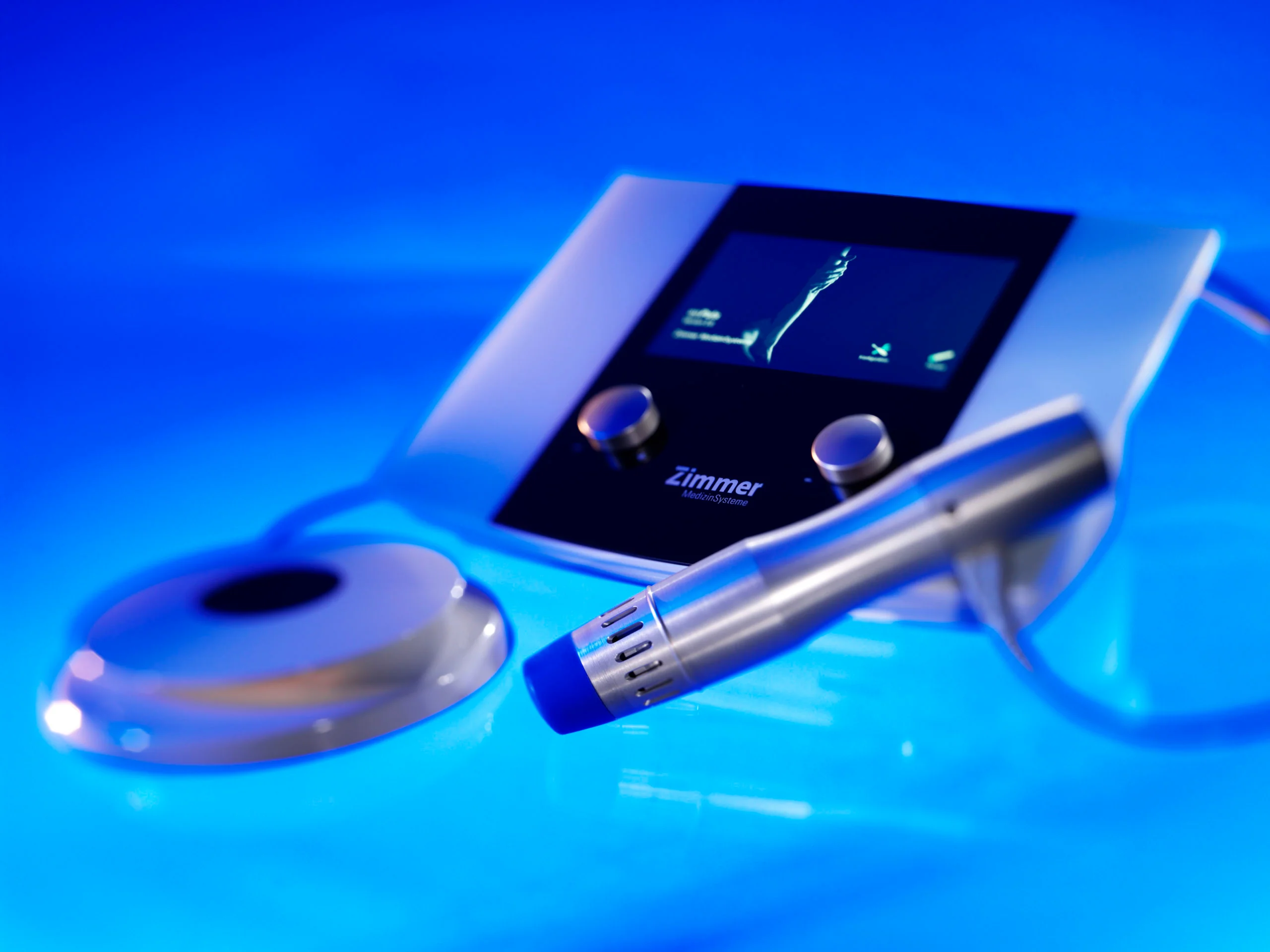
At Riverside Chiropractic in London, Ontario, shockwave therapy is delivered using the Zimmer enPuls 2.0, a clinical-grade radial shockwave system made in Germany. The enPuls 2.0 uses softshot technology, which generates the therapeutic pressure wave using a heavier projectile at a lower impact speed than standard compressed-air devices. The result is equivalent clinical effectiveness with significantly improved patient comfort, which matters when the treatment area is already painful.
Here’s what a typical course of shockwave treatment for plantar fasciitis looks like at Riverside:
Before any shockwave treatment begins, Dr. Ben assesses your foot, heel, and lower limb to confirm that plantar fasciitis is the right diagnosis and that shockwave is the appropriate intervention for your specific presentation. Shockwave isn’t right for every case, and understanding what’s driving your heel pain before starting treatment is essential.
A typical treatment session runs 10 to 15 minutes. The applicator is placed at the heel and the pressure waves are delivered to the plantar fascial attachment. Most patients describe the sensation as a deep, rhythmic pressure. Some find it mildly uncomfortable in the first session, particularly over the most sensitive areas, and most find subsequent sessions more tolerable as the tissue begins to respond.
Most patients complete three to six sessions spaced approximately one week apart. Some notice meaningful improvement after the first or second session. Others find the most significant relief in the weeks following the full course of treatment as the tissue continues to heal and remodel. Dr. Ben tracks your progress throughout and adjusts the plan based on how you’re responding.
Shockwave at Riverside is used as part of a broader care plan rather than as a standalone treatment. Depending on your assessment findings, this may also include chiropractic care for any related spinal or lower limb mechanical issues, soft tissue therapy, custom foot orthotics to address biomechanical contributors, and a home exercise program to support long-term recovery.
Who Is a Good Candidate for Shockwave Therapy for Plantar Fasciitis?
Shockwave therapy tends to produce the best results for patients who:
Have had plantar fasciitis for three months or longer and haven’t fully responded to rest, stretching, orthotics, or cortisone injections. Are experiencing significant pain at the heel insertion point, particularly with first steps in the morning or after periods of rest. Want to avoid surgery or repeated cortisone injections. Are willing to complete a full course of three to six sessions rather than expecting results from a single treatment.
It may not be the right first step for patients with very recent or acute heel pain, since many acute presentations resolve with conservative care. It’s also not appropriate in certain situations including pregnancy, active infection in the treatment area, or certain blood clotting conditions. Dr. Ben screens for these contraindications as part of the initial assessment.
Plantar Fasciitis Shockwave Therapy in London, Ontario
If you’ve been dealing with heel pain that isn’t getting better, or that keeps coming back despite trying the usual approaches, shockwave therapy at Riverside Chiropractic may be the intervention that finally moves things forward.
Dr. Ben Tucker has been practicing chiropractic in London, Ontario since 2014 and now offers shockwave therapy using the Zimmer enPuls 2.0 at Riverside Chiropractic, located at 110 Riverside Dr., Suite 104 in Old South London. No referral is needed. The first step is a comprehensive assessment to confirm the diagnosis and determine whether shockwave is the right fit for your situation.
Frequently Asked Questions
How many shockwave therapy sessions do I need for plantar fasciitis?
Most patients complete three to six sessions spaced approximately one week apart. The exact number depends on how chronic the condition is and how your tissue responds. Dr. Ben tracks your progress throughout and adjusts the plan accordingly.
Is shockwave therapy painful for plantar fasciitis?
The Zimmer enPuls 2.0 used at Riverside Chiropractic uses softshot technology specifically designed to improve patient comfort. Most patients describe a deep, rhythmic pressure during treatment. Some find the first session mildly uncomfortable over the most sensitive areas, with subsequent sessions typically more tolerable.
How long does it take to see results?
Some patients notice improvement after the first or second session. Others find the most meaningful relief in the weeks following the full course of treatment as the tissue continues to heal. Results vary by individual and by how chronic the condition is.
Can shockwave therapy be combined with orthotics for plantar fasciitis?
Yes. Custom foot orthotics address the biomechanical contributors to plantar fasciitis while shockwave promotes tissue healing at the fascial attachment. The two work well together as part of a comprehensive care plan.
Is shockwave therapy covered by insurance for plantar fasciitis in Ontario?
Coverage varies by insurer and plan. We recommend checking with your provider directly. Riverside Chiropractic provides receipts for all services for self-submission to your extended health benefits plan.
What’s the difference between shockwave therapy and a cortisone injection for plantar fasciitis?
Cortisone injections reduce inflammation quickly but provide temporary relief and carry risks with repeated use including weakening of the fascial tissue. Shockwave works at the tissue level to promote structural repair and tends to produce more durable long-term outcomes. Studies comparing the two generally find shockwave produces better results over the longer term.